Exploring Halal Business Opportunities between Canada and ASEAN in the Indonesia Canada CEPA Era
- 12 hours ago
- 4 min read

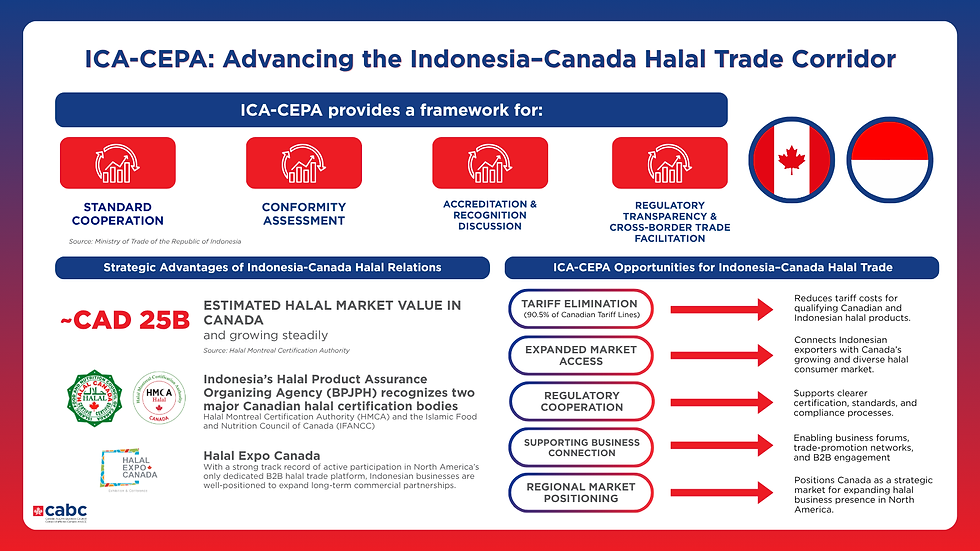
On July 16, 2026, the Canada-ASEAN Business Council (CABC) and the Indonesian Chamber of Commerce and Industry (Kadin Indonesia) hosted a webinar titled “Exploring Halal Business Opportunities between Canada and Indonesia in the ICA-CEPA Era.” The event brought together over 70 participants from Indonesia, Canada, and across Southeast Asia, including government representatives, industry leaders, halal certification authorities, business associations, and private-sector stakeholders. The webinar was primarily designed for Indonesian businesses interested in exploring opportunities in the Canadian halal market. The discussion examined the broader potential for Canada-Indonesia economic integration through the development of a halal trade corridor, leveraging Canada’s first bilateral free trade agreement with an ASEAN member and Indonesia’s first with a North American country. Speakers highlighted that the Indonesia-Canada Comprehensive Economic Partnership Agreement (ICA-CEPA) will strengthen bilateral trade through substantial tariff liberalization and closer regulatory cooperation. Under the agreement, Canada will eliminate tariffs on 90.5% of trade lines, permanently locking in 0% rates for 5,048 lines and gradually phasing out duties on 1,525 others, while Indonesia will liberalize 85.5% of tariff lines, covering 95% of Canadian exports.

(Source: Presentation from Youshy Fahreiza, Deputy Director / Associate Trade Negotiator, Ministry of Trade of the Republic of Indonesia)
Beyond tariff liberalization, ICA CEPA also provides a comprehensive framework to promote investment, expand trade in services, strengthen regulatory cooperation, and foster long-term commercial partnerships. The discussion also challenged the perception of Canada as a relatively small halal market. Speakers emphasized that Canada offers a stable, transparent, and high-income consumer market, with an estimated halal economy valued at more than CAD 25 billion and supported by steady growth and government engagement. Demand is expanding across food, pharmaceuticals, cosmetics, nutraceuticals, and financial services, driven by Canada’s diverse population and the broader perception of halal products as safe, high-quality, health-conscious, and environmentally responsible. The growing halal market in Canada offers strong diversification opportunities for Indonesian exporters. At present, Indonesia’s Halal Product Assurance Organizing Agency (BPJPH) recognizes two major Canadian halal certification bodies: the Halal Montreal Certification Authority (HMCA) and the Islamic Food and Nutrition Council of Canada (IFANCC). Their recognition provides a strong foundation for the development of a Canada-Indonesia halal corridor. These institutions can support Canadian businesses seeking to obtain halal certification ahead of Indonesia’s mandatory halal requirements for imported food and beverages, cosmetics, traditional medicines, and certain chemical products, which are scheduled to take effect in October 2026. They can also assist Indonesian exporters in navigating the requirements, consumer expectations, and evolving dynamics of Canada’s halal market. To succeed in the Canadian market, Indonesian companies must comply with relevant Canadian regulatory standards. Key requirements include bilingual labelling in English and French, comprehensive nutrition facts tables, clear disclosure of priority allergens, and robust quality-assurance systems. However, regulatory compliance alone is not sufficient. International buyers seek reliable, long-term partners rather than individual products or one-off transactions. While government policies and free trade agreements establish the regulatory foundation for market access, sustained commercial success depends on building trusted partnerships and consistently demonstrating compliance, product quality, and supply reliability. Trade shows play an important role in developing these relationships by providing exporters with opportunities to demonstrate their halal integrity, product quality, and export readiness directly to prospective buyers and partners. Halal Expo Canada, one of North America’s leading business-to-business trade shows dedicated to the halal ecosystem, offers a valuable platform for Indonesian companies seeking to enter or expand within the Canadian market. Ultimately, exporters are more likely to succeed in Canada and the wider North American market by prioritizing professional branding, complete documentation, regulatory preparedness, and long-term relationship-building over one-off sales.
The Path Forward Looking ahead, the priority is to translate the opportunities created by ICA-CEPA into tangible commercial outcomes by strengthening cooperation among governments, halal certification bodies, business associations, trade-promotion agencies, and private-sector stakeholders. Through sustained coordination and practical business facilitation, Canada and Indonesia can develop a trusted and commercially viable halal corridor that supports greater two-way trade, investment, and long-term partnerships.
CABC and Kadin Indonesia would like to express our sincere gratitude to our distinguished speakers: H.E. Muhsin Syihab, Ambassador of Indonesia to Canada; Bernardino M. Vega, Vice Chair for Foreign Relations, Kadin Indonesia; Youshy Fahreiza, Deputy Director / Associate Trade Negotiator, Ministry of Trade of the Republic of Indonesia; Younes Baaja, Business Director, Halal Montreal Certification Authority; and Nasser Deeb, Exhibitions Director, Halal Expo Canada and Halal Expo Philippines, for sharing their expertise and practical insights in this important discussion.
Key Takeaways
ICA-CEPA will improve market access through tariff reductions, regulatory cooperation, and stronger investment and services provisions.
Canada is a growing halal market worth more than CAD 25 billion across food, cosmetics, pharmaceuticals, nutraceuticals, and finance.
HMCA and IFANCC can support certification for Canadian exporters to Indonesia and support Indonesian businesses in navigating Canada’s halal market.
Exporters must meet Canadian requirements on bilingual labels, nutrition facts, allergens, documentation, and quality assurance.
Long-term success depends on trusted partnerships, strong branding, reliable supply, and direct engagement with buyers.